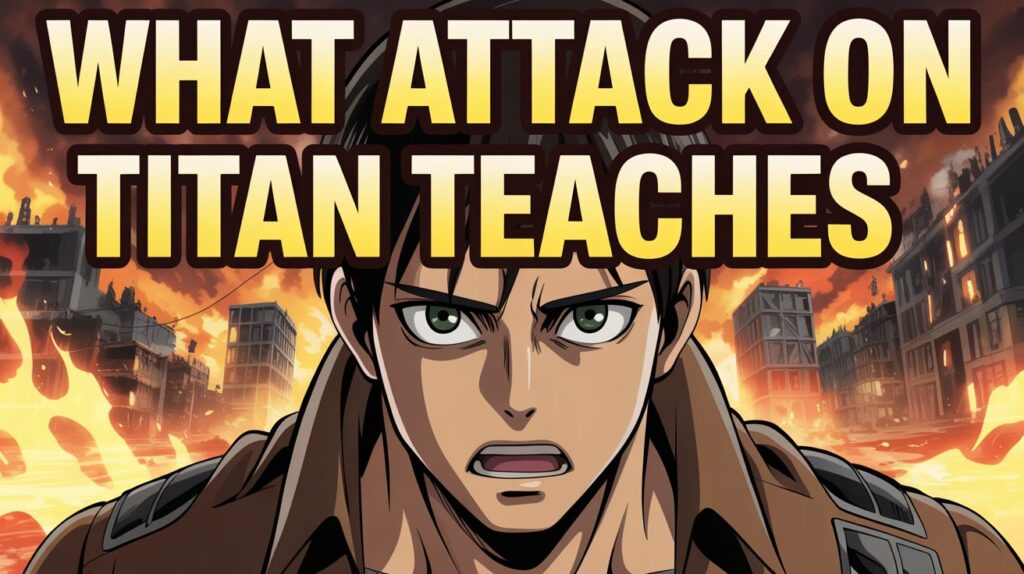

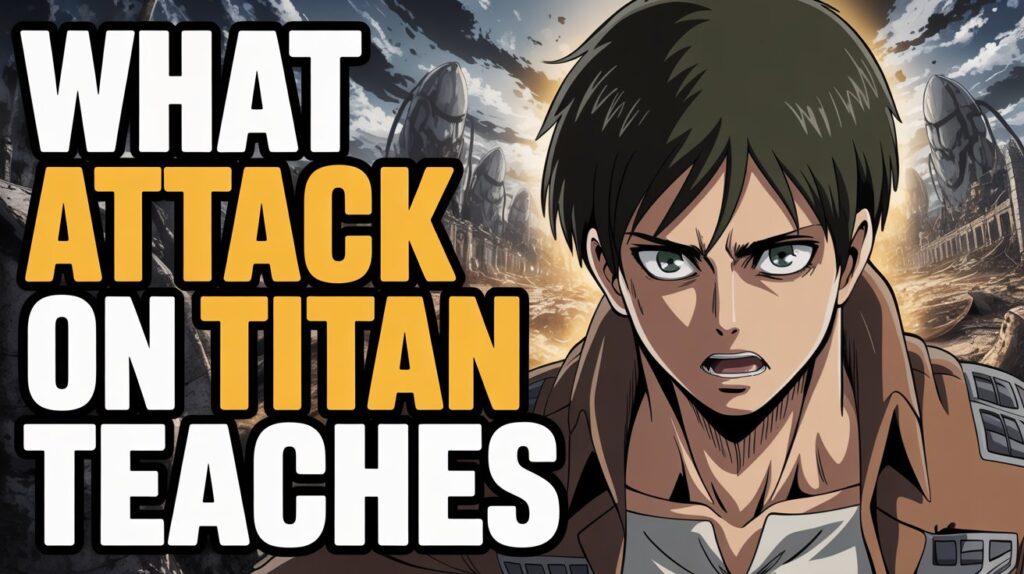
Few anime series have sparked as much global discussion, controversy, and philosophical reflection as Attack on Titan. What begins as a survival story against monstrous Titans slowly transforms into one of the most complex narratives ever written about war, power, fear, and human nature. Beneath its intense action and shocking twists, Attack on Titan functions as a deep commentary on humanity itself. What Attack on Titan Teaches Us About War and Humanity.
This is not an anime that offers comfort or easy answers. Instead, it forces viewers to confront uncomfortable truths about violence, nationalism, freedom, revenge, and moral compromise. For students, thinkers, and general audiences alike, Attack on Titan becomes less of an entertainment series and more of a philosophical case study on how wars begin, how they are justified, and how they ultimately consume everyone involved.
Table of Contents
Why Attack on Titan Feels Uncomfortably Real
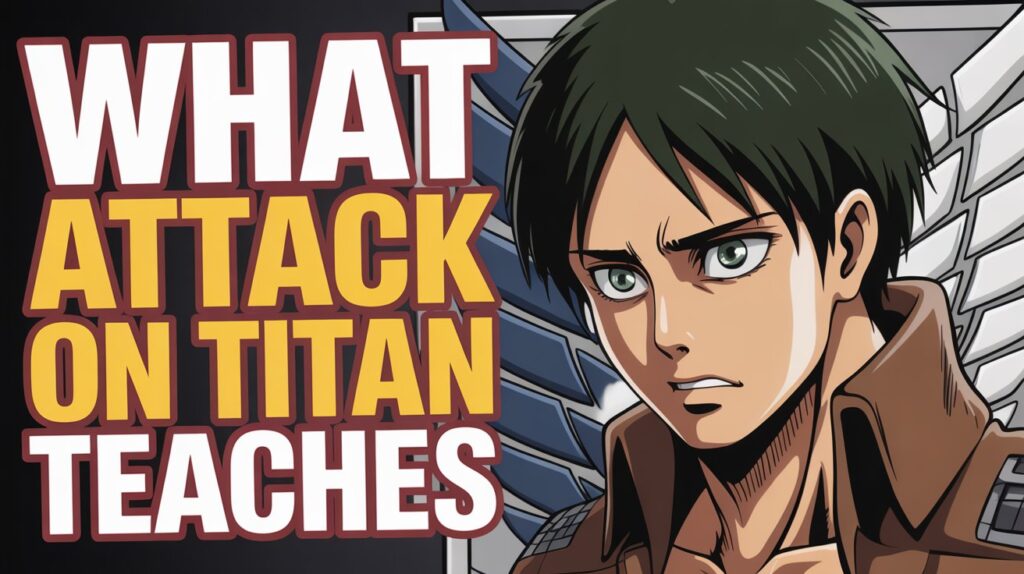
Attack on Titan resonates so strongly because it mirrors real-world conflicts without directly referencing them. The series presents war not as heroic spectacle, but as a cycle driven by fear, propaganda, historical trauma, and dehumanization.
From the very beginning, humanity lives behind walls, taught to fear what lies beyond. This isolationist mindset feels familiar in a world divided by borders, ideologies, and political narratives. The enemy is portrayed as inhuman, unknowable, and deserving of annihilation. This framing is not accidental. It reflects how real wars are often sold to the public.
The brilliance of Attack on Titan lies in its slow dismantling of this narrative. As the story progresses, the line between victim and villain erodes, forcing viewers to question every assumption they once held.
War Begins With Fear, Not Hatred
One of the most important lessons Attack on Titan teaches is that war does not begin with hatred. It begins with fear. Fear of the unknown. Fear of extinction. Fear of losing identity.
The people inside the walls are raised to believe that Titans are monsters with no emotions or history. Similarly, those outside the walls are taught that the people within are devils who threaten the world’s survival.
In both cases, fear is institutionalized. It becomes part of education, culture, and governance. Once fear takes root, violence becomes easy to justify.
This reflects real-world warfare, where governments often rely on fear-based narratives to gain public support. When fear dominates reason, empathy disappears.
Dehumanization as the Foundation of Violence
Attack on Titan repeatedly shows that large-scale violence is only possible when one group stops seeing the other as human. Titans are initially portrayed as mindless creatures. Later, entire populations are labeled as devils.
This dehumanization serves a purpose. It removes moral hesitation.
Once enemies are stripped of individuality, suffering becomes acceptable. Death becomes statistics. Civilian casualties become collateral damage.
The series forces viewers to confront a disturbing reality. Most humans are not inherently violent. They must first be convinced that the other side is less than human.
The Illusion of Moral Superiority in War
Throughout Attack on Titan, every faction believes it is morally justified. Each side sees itself as the victim acting in self-defense.
This is one of the series’ most powerful messages. War thrives on moral certainty. The belief that one side is absolutely right makes compromise impossible.
Attack on Titan dismantles this belief by revealing layered histories. Past atrocities justify present violence. Present violence creates future hatred. The cycle never ends.
The anime suggests that moral absolutism is one of the most dangerous forces in human history. When people stop questioning their righteousness, cruelty becomes normalized.
Freedom as a Double-Edged Concept
Few concepts are explored as deeply in Attack on Titan as freedom. Nearly every major character claims to fight for it. Yet, their definitions of freedom often contradict one another.
For some, freedom means safety. For others, it means dominance. For some, it means survival. For others, it means revenge.
The series challenges the idea that freedom is inherently good. It asks a difficult question. What happens when one person’s freedom requires another person’s destruction?
This question has shaped real-world wars for centuries. Nations fight in the name of freedom while denying it to others. Attack on Titan exposes how easily noble ideals can be weaponized.
How War Destroys Innocence
One of the most painful aspects of Attack on Titan is its portrayal of lost innocence. Children are not shielded from war. They are trained for it. Conditioned for it. Sacrificed for it.
The anime does not romanticize this process. It shows the emotional damage inflicted on young soldiers, the numbness that replaces fear, and the guilt that lingers long after battles end.
This reflects real conflicts, where generations grow up knowing nothing but war. Attack on Titan reminds us that the true cost of war is not measured only in casualties, but in broken futures.
The Role of Propaganda and Controlled Narratives
Information control plays a crucial role in Attack on Titan. History is altered. Truth is hidden. Entire populations live under carefully constructed lies.
This is not presented as a twist, but as a warning.
Those in power understand that controlling the narrative is more effective than controlling territory. When people believe a certain version of history, they act accordingly.
The series highlights how propaganda:
- Shapes identity
- Justifies violence
- Silences dissent
- Normalizes oppression
In this way, Attack on Titan becomes a commentary on media, education, and political storytelling.
Collective Guilt and Inherited Sin
One of the darkest themes in Attack on Titan is inherited guilt. Entire generations are punished for crimes committed long before they were born.
The series questions the morality of collective punishment. Can children be held responsible for the actions of ancestors? Can suffering ever truly balance historical wrongs?
By presenting characters trapped by inherited blame, Attack on Titan exposes the cruelty of judging individuals by group identity. This theme directly mirrors ethnic conflicts and historical grievances in the real world.
Revenge as an Endless Cycle
Revenge fuels much of Attack on Titan’s narrative. Characters seek justice for personal loss, only to become perpetrators of similar suffering.
The anime does not glorify revenge. It portrays it as emotionally hollow. Each act of vengeance creates new victims who will one day seek their own retribution.
This endless cycle mirrors real wars rooted in historical resentment. Attack on Titan suggests that revenge offers no resolution, only continuation.
Leadership and the Burden of Choice
Attack on Titan presents leadership as deeply isolating. Leaders are forced to make decisions that cost lives. There are no clean choices, only lesser evils.
The series rejects the idea of heroic leadership. Instead, it shows leaders weighed down by guilt, uncertainty, and consequence.
This portrayal feels strikingly realistic. War leaders rarely emerge unscathed. The emotional toll of command is often invisible, but profound.
Humanity’s Capacity for Cruelty and Compassion
Despite its darkness, Attack on Titan does not argue that humanity is evil. Instead, it presents humans as capable of both immense cruelty and profound compassion.
Acts of kindness exist alongside atrocities. Empathy survives even in battlefields. Characters question orders. Some choose mercy over obedience.
This balance prevents the series from becoming nihilistic. It suggests that while humans are capable of terrible things, they are also capable of reflection and change.
Key Lessons About War and Humanity from Attack on Titan
| Theme | What the Series Teaches |
|---|---|
| Fear | War begins with fear, not hatred |
| Dehumanization | Violence becomes easier when empathy disappears |
| Moral certainty | Absolute righteousness fuels cruelty |
| Freedom | Ideals can be weaponized |
| Propaganda | Control of truth shapes behavior |
| Revenge | Creates endless cycles of suffering |
| Leadership | No choice in war is without cost |
| Humanity | Compassion survives even in darkness |
Why Attack on Titan Appeals to Mature Audiences
Attack on Titan resonates strongly with older teens and adults because it refuses simplicity. It respects the viewer’s intelligence. It trusts the audience to sit with discomfort.
Unlike many action-driven narratives, it prioritizes consequence over spectacle. Death matters. Decisions linger. Trauma is not forgotten.
This maturity makes Attack on Titan particularly relevant in an era defined by global conflict, political polarization, and moral confusion.
What Attack on Titan Ultimately Says About Humanity
At its core, Attack on Titan argues that humanity’s greatest enemy is not an external monster. It is fear, ignorance, and the refusal to understand one another.
The Titans were never the true threat. Human choices were.
This realization transforms the series from a survival story into a moral exploration. It asks viewers to examine their own beliefs, biases, and assumptions.
Final Thoughts
Attack on Titan is not an anime designed to comfort. It is designed to confront. It challenges viewers to question how wars are justified, how enemies are created, and how humanity often betrays its own values in the name of survival.
In doing so, it becomes more than a story. It becomes a warning.
War, as Attack on Titan shows, is rarely about monsters. It is about people. Their fears. Their choices. Their unwillingness to see one another as human.
That is what makes the series unforgettable, and deeply relevant long after the final episode ends.
Also Read: “What If Light Yagami Was Never Found Out, Death Note Alternate Timeline“
FAQs
Is Attack on Titan an anti-war anime?
Yes. While it contains intense action, its core message critiques war, violence, and ideological extremism.
What does Attack on Titan say about humanity?
It portrays humanity as complex, capable of both immense cruelty and profound compassion.
Why is Attack on Titan considered mature storytelling?
Because it explores moral ambiguity, trauma, and consequences rather than simple heroism.