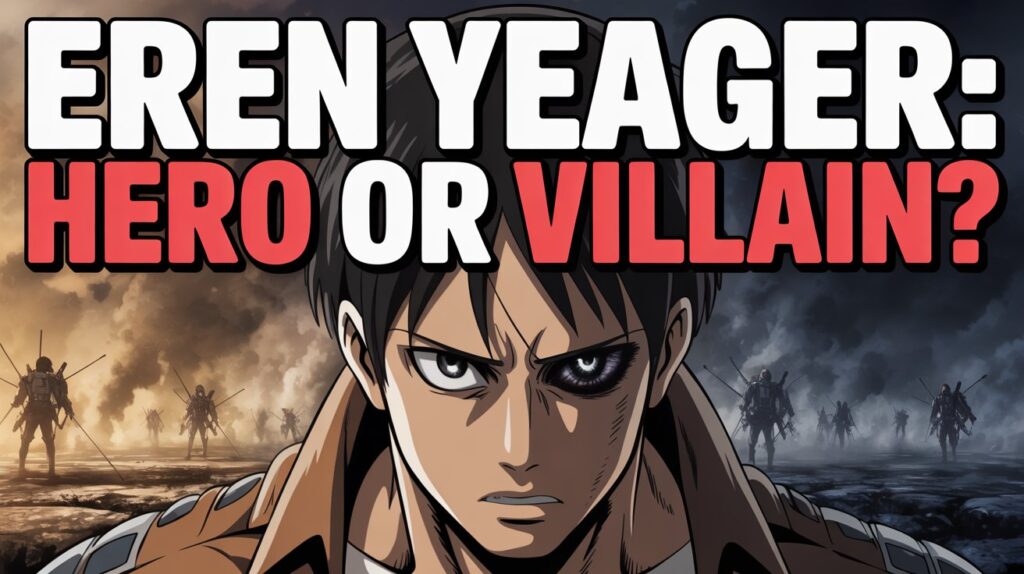

Few anime characters have divided audiences as sharply as Eren Yeager. Introduced as a passionate, freedom-driven child and later transformed into one of anime’s most controversial figures, Eren’s journey forces viewers to confront uncomfortable questions about morality, justice, and human nature. He is neither easily admired nor easily condemned.
Within Attack on Titan, Eren Yeager becomes more than a protagonist. He becomes a philosophical problem. Is he a hero who chose an unbearable burden to protect his people, or a villain who justified mass destruction in the name of freedom? The brilliance of his character lies in the fact that the story never provides a simple answer.
This article explores Eren Yeager through the lens of moral philosophy, war ethics, and human psychology. Written in an editorial and analytical tone, it examines whether Eren should be understood as a hero, a villain, or something far more unsettling, a reflection of humanity itself.
Table of Contents
The Evolution of Eren Yeager
Eren’s transformation is gradual and intentional. He begins as an impulsive child whose worldview is shaped by trauma, loss, and fear. The destruction of his home and the death of his mother ignite a singular belief, freedom must be achieved at any cost.
As the story progresses, Eren gains knowledge, power, and perspective. What changes is not his desire for freedom, but his understanding of what freedom requires. The shift from idealism to extremism is not sudden. It is layered, logical, and deeply disturbing.
This slow evolution mirrors real-world radicalization. Individuals rarely become extreme overnight. They are shaped by fear, history, and perceived injustice.
Defining Hero and Villain in Attack on Titan
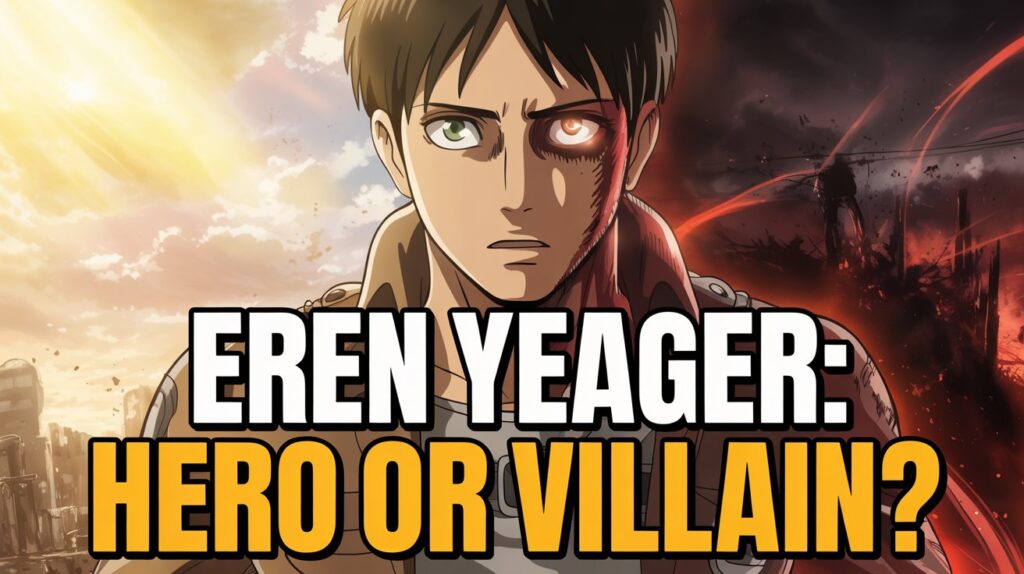
Traditional storytelling defines heroes as protectors and villains as destroyers. Attack on Titan deliberately rejects this binary. In its world, every side believes it is acting in self-defense.
Eren challenges the viewer to reconsider these labels. He protects his people, yet annihilates others. He seeks freedom, yet removes it from millions.
Rather than asking whether Eren fits the role of hero or villain, the series asks a more difficult question. Can moral categories survive in a world shaped by total war?
Eren Yeager and the Philosophy of Freedom
Freedom is Eren’s core motivation. From childhood, he views freedom as the absence of cages, walls, and control. Yet as he matures, freedom becomes more abstract and dangerous.
Eren’s philosophy suggests that freedom is not passive. It must be seized, even violently, if necessary. This aligns with existentialist ideas, where individuals create meaning through action, regardless of consequence.
However, Eren’s interpretation becomes absolute. If his people are not free, no one deserves freedom.
This is where philosophy turns into fanaticism.
Utilitarianism and Eren’s Justification
One of the strongest philosophical frameworks to analyze Eren is utilitarianism, the idea that actions are justified if they produce the greatest good for the greatest number.
Eren believes that destroying the outside world will secure peace for his people. In his mind, sacrificing millions is justified if it guarantees the survival of his homeland.
From a strict utilitarian perspective, his logic follows a grim consistency. Yet the series exposes the flaw in this thinking. Who decides whose lives are worth more?
Attack on Titan highlights the danger of utilitarianism when detached from empathy. Numbers replace faces. Suffering becomes abstract.
Deontology and the Moral Line Eren Crosses
Deontological ethics argue that certain actions are inherently wrong, regardless of outcome. Mass murder, under this framework, is never justified.
From this perspective, Eren is unquestionably a villain.
The series does not dispute this. Instead, it allows both ethical frameworks to exist in tension. Eren’s actions may achieve strategic goals, but they violate fundamental moral principles.
This duality is intentional. It forces viewers to confront their own moral limits.
The Psychology of Inevitability
One of the most tragic elements of Eren’s character is his belief in inevitability. Through his powers, he perceives future events as fixed. This creates a psychological prison where free will feels like an illusion.
Eren does not see himself as choosing genocide. He sees himself as fulfilling destiny.
This mindset reflects real-world justifications for violence. When people believe outcomes are inevitable, accountability dissolves. Responsibility shifts from choice to fate.
Attack on Titan challenges this belief by subtly questioning whether Eren truly lacked alternatives, or whether he surrendered to despair.
Fear as the Root of Violence
Eren’s actions are often framed as courage, but beneath them lies profound fear. Fear of extinction. Fear of loss. Fear of repeating history.
The series repeatedly shows that fear, not hatred, fuels violence. Eren’s fear mirrors that of his enemies, creating a tragic symmetry.
By portraying both sides as driven by the same emotion, the story dismantles the idea of moral superiority in war.
Nationalism and Collective Identity
Eren’s transformation coincides with a shift from personal motivation to collective ideology. He no longer fights as an individual, but as a symbol of his people’s survival.
This shift reflects the dangers of extreme nationalism. Individual morality dissolves into collective destiny. Violence becomes justified as historical necessity.
Attack on Titan does not condemn patriotism. It condemns the moment when identity becomes an excuse for annihilation.
The Burden of Choice and Isolation
Unlike many villains, Eren does not enjoy power. He carries it like a curse. His isolation increases as his actions escalate.
This loneliness is not accidental. It represents the emotional cost of moral extremism. The further Eren goes, the fewer people can stand beside him.
Leadership in war, the series suggests, is often lonely because it requires choices that cannot be shared or forgiven.
Is Eren Yeager a Tragic Hero?
In classical literature, a tragic hero is defined by noble intentions undone by fatal flaws. Eren fits this model uncomfortably well.
His flaw is absolutism. His inability to accept coexistence or compromise leads him toward destruction. His intentions begin with protection, but end in annihilation.
This tragic framing does not absolve him. It explains him.
Victims Without Voices
One of the most powerful critiques embedded in Attack on Titan is the silence of Eren’s victims. The narrative does not dwell on their stories, reflecting how mass violence erases individuality.
This absence is intentional. It mirrors how real-world atrocities reduce human lives to statistics.
By denying the audience emotional closure, the series emphasizes the true cost of Eren’s actions.
Moral Responsibility Versus Understanding
Understanding Eren does not mean excusing him. The series carefully maintains this distinction.
Viewers are invited to empathize with his pain while condemning his choices. This tension is uncomfortable, but necessary.
Attack on Titan refuses to let moral complexity become moral neutrality.
Eren Yeager Compared to Traditional Anime Protagonists
Most anime protagonists grow stronger while remaining morally consistent. Eren grows stronger while becoming morally fractured.
This inversion is one of the series’ boldest narrative decisions. It challenges the idea that power and righteousness naturally align.
Eren’s arc warns against blind admiration of strength without ethical reflection.
Key Moral Questions Raised by Eren Yeager
| Moral Question | How the Series Responds |
|---|---|
| Is violence justified for survival? | Only at unbearable cost |
| Can freedom be forced? | Forced freedom becomes oppression |
| Are outcomes more important than actions? | Actions leave irreversible scars |
| Is fate an excuse for cruelty? | Belief in fate erodes accountability |
| Can heroes commit atrocities? | Yes, and that is the tragedy |
Why Audiences Remain Divided
Eren Yeager divides audiences because he reflects real moral conflicts. Viewers bring their own values, experiences, and fears into their judgment.
Some see him as a protector who sacrificed his humanity. Others see him as a cautionary tale of unchecked ideology.
The lack of a definitive answer is not a flaw. It is the point.
What Eren Yeager Ultimately Represents
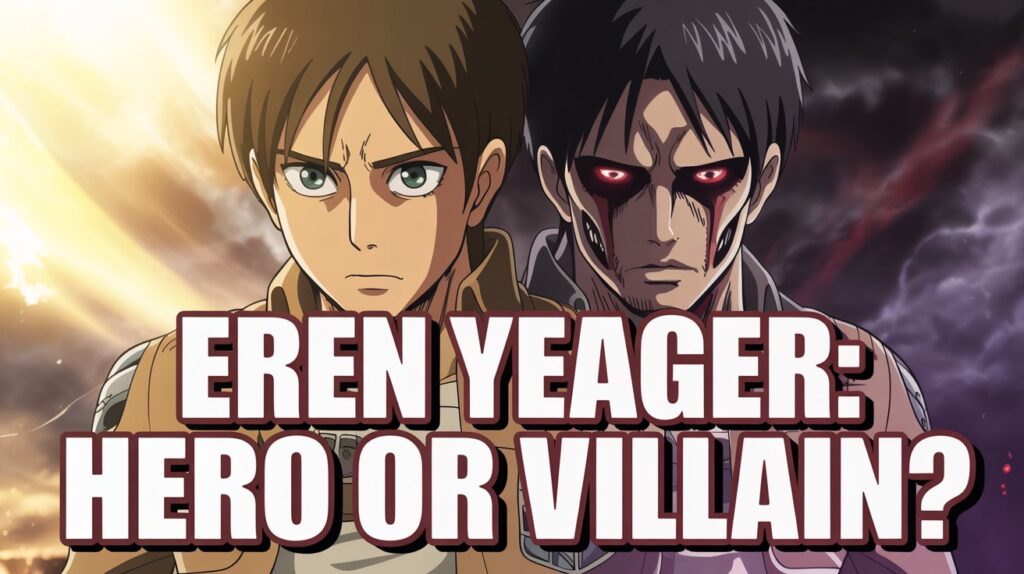
Eren is not meant to be a role model or a monster. He is a mirror.
He reflects:
- Humanity’s fear of extinction
- The temptation of absolute solutions
- The cost of abandoning empathy
- The danger of believing violence is destiny
In this sense, Eren Yeager is not just a character. He is a philosophical warning.
Final Thoughts
So, is Eren Yeager a hero or a villain?
Attack on Titan refuses to choose, because real history rarely does. Eren exists in the uncomfortable space where good intentions collide with unforgivable actions. He forces viewers to confront the limits of empathy and the consequences of moral certainty.
By refusing simplicity, Eren Yeager becomes one of anime’s most profound characters. Not because he offers answers, but because he asks questions that linger long after the story ends.
That is what makes his journey unforgettable, unsettling, and deeply human.
Also Read: “Life Lessons from One Piece for Students“
FAQs
Is Eren Yeager a villain?
From an ethical standpoint, yes. His actions violate fundamental moral principles despite understandable motivations.
Did Eren have a choice?
The story suggests determinism, but moral responsibility remains because awareness does not remove accountability.
What philosophy best explains Eren Yeager?
A combination of utilitarianism, moral relativism, and fatalism explains his decisions and downfall.