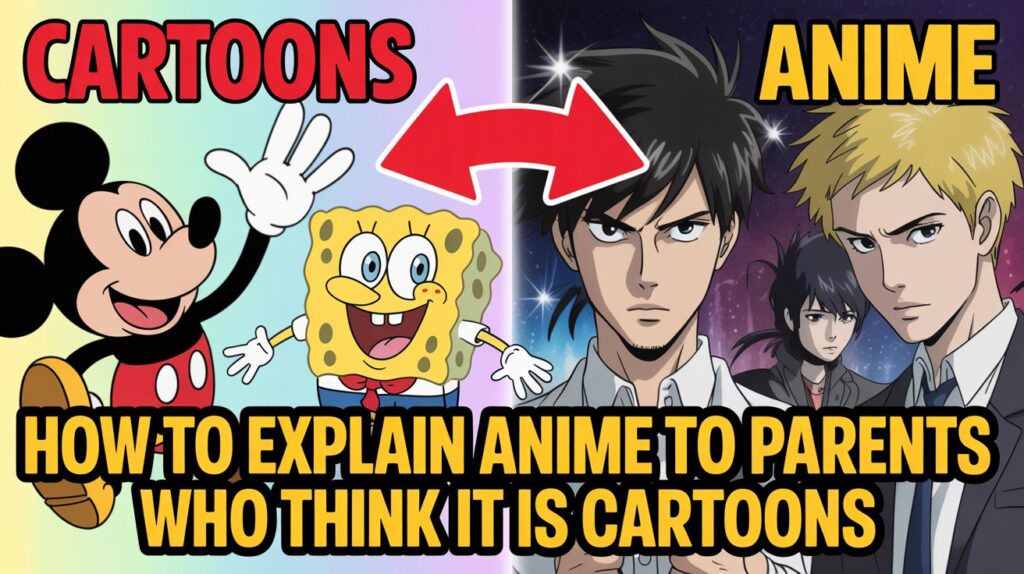

If you have ever tried telling your parents that anime is not “just cartoons,” you probably faced the same reaction: “Isn’t that for kids?”
This misunderstanding is common, especially in households where animated content was traditionally associated with children’s entertainment. But anime is far more than colorful characters and exaggerated expressions. It is a multi-billion-dollar global industry, a storytelling medium, and in many cases, a deeply philosophical art form. How to Explain Anime to Parents Who Think It Is Cartoons?
In this comprehensive guide, we will explore how to explain anime to parents in a way that is respectful, logical, and persuasive. Whether you are a teenager defending your favorite series or an adult anime fan trying to bridge generational gaps, this article will give you the right arguments, examples, and context.
Table of Contents
Understanding the Root of the Misunderstanding
Before explaining anime to parents, it helps to understand why they think it is “just cartoons.”
In many countries, animated shows like Saturday morning programs were designed primarily for children. Classic Western animation focused on humor, slapstick, and simple moral lessons. Because of that historical context, older generations often equate animation with children’s content.
Anime, however, evolved differently in Japan. It became a storytelling medium used across all age groups. From romance and horror to psychological thrillers and political drama, anime spans genres that rival live-action cinema.
The first step is not arguing. The first step is educating.
What Is Anime, Really?
Anime refers to animated productions originating from Japan. It is not a genre. It is a medium. Just like movies or television dramas, anime includes multiple genres, tones, and target audiences.
To help parents understand, you can use this simple comparison:
| Medium | For Kids | For Teens | For Adults |
|---|---|---|---|
| Books | Fairy Tales | Young Adult Fiction | Literary Fiction |
| Movies | Pixar Films | Superhero Movies | Crime Thrillers |
| Anime | Kids Anime | Shonen, Shojo | Seinen, Josei |
When parents see anime through this lens, it becomes easier to understand that it is not a “type” of content, but a format of storytelling.
Show, Don’t Just Tell: Use Strong Examples
Sometimes explanation is not enough. Examples help.
Thought-Provoking Anime
- Death Note explores morality, justice, and psychological conflict.
- Attack on Titan deals with war, freedom, political manipulation, and human survival.
- Spirited Away, directed by Hayao Miyazaki, won an Academy Award and is studied in film schools.
- Your Name is a romantic drama about fate, time, and connection.
Ask your parents: Would you call these topics childish?
Framing anime as storytelling about serious human issues helps dismantle the “cartoon” stereotype.
Explain the Cultural Context
Anime reflects Japanese culture, social issues, and philosophy.
For example:
- Respect for tradition and elders
- Social pressure and academic expectations
- The concept of honor
- Post-war national identity
Parents often appreciate cultural depth. When they understand that anime carries cultural storytelling similar to Indian cinema, Korean dramas, or Western literature, they begin to see its legitimacy.
Anime is not escapism alone. It is cultural expression.
Address the Visual Style Misconception
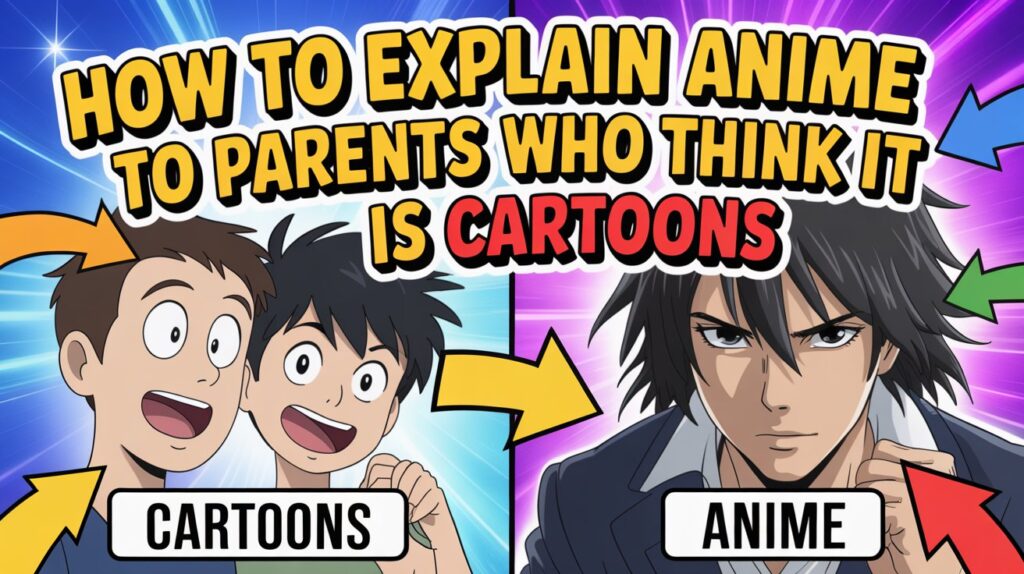
Many parents focus on the visual style: big eyes, colorful hair, exaggerated expressions.
Explain that stylization does not mean immaturity.
Consider this:
- Pixar films use stylized characters
- Superhero movies use unrealistic visuals
- Mythological films use exaggerated costumes
Stylization is a creative choice. It enhances emotion and expression.
Anime uses visual exaggeration as a storytelling tool, not as childish decoration.
Compare Anime to Books and Cinema
Parents often respect books and films. Use that comparison strategically.
You can say:
“Anime is like a novel that happens to be animated. Some novels are for children, others are for adults. Same with anime.”
For example:
- Naruto focuses on perseverance and personal growth.
- Demon Slayer: Kimetsu no Yaiba explores family bonds and sacrifice.
- Vinland Saga dives into revenge, trauma, and the meaning of violence.
These themes are universal and mature.
The Psychological Depth of Anime
Many anime series explore emotional struggles more intensely than live-action shows.
Characters experience:
- Identity crises
- Existential questions
- Moral dilemmas
- Grief and trauma
Anime often spends entire arcs on character growth. Parents who value literature and philosophy can relate to this depth.
You can highlight how anime encourages empathy and emotional intelligence.
Academic and Global Recognition
Anime is no longer niche.
- It is streamed globally on major platforms
- It wins international awards
- It generates billions in revenue annually
- It influences global fashion and art
The success of studios like Studio Ghibli shows that anime is respected worldwide.
This is not underground content. It is global entertainment culture.
Address Their Concerns Honestly
Parents may worry about:
- Violence
- Obsession
- Time management
- Inappropriate themes
Instead of dismissing their concerns, acknowledge them.
Yes, some anime contains mature themes. But the same applies to movies and television. The key is responsible viewing.
You can reassure them by:
- Watching age-appropriate content
- Maintaining balance in studies and responsibilities
- Avoiding extreme binge habits
When parents see maturity in your approach, their perception shifts.
Why the “Cartoon” Label Persists
Historically, Western animation was dominated by children’s content. Because anime uses animation, it is automatically categorized the same way.
But the reality is this:
Animation is a technique. Not a genre.
It is similar to saying:
“All novels are children’s stories because fairy tales exist.”
That logic clearly does not hold.
Generational Perspective Gap
There is also a generational shift in media consumption.
Younger generations grew up with:
- Streaming platforms
- Global content access
- Subtitled international shows
Older generations grew up with limited channels and curated programming.
Understanding this gap helps reduce frustration during discussions.
Invite Them to Watch With You
One of the most effective ways to explain anime is shared experience.
Choose something accessible and meaningful.
Good starter recommendations:
- Spirited Away
- A Silent Voice
- The Wind Rises
These films focus on emotional storytelling rather than action-heavy sequences, making them easier entry points for skeptical viewers.
Explain That Anime Covers All Genres
Anime includes:
- Romance
- Horror
- Sci-fi
- Sports
- Political drama
- Psychological thrillers
For example:
- Haikyuu!! focuses on teamwork and ambition.
- Erased explores crime and time travel.
- Monster is a psychological thriller comparable to Western crime dramas.
Parents may relate better when you compare these to genres they already enjoy.
Emotional Maturity in Anime
Anime often handles themes like:
- Loss of parents
- War trauma
- Social isolation
- Mental health
These are not child-focused topics.
In fact, some anime is more emotionally intense than mainstream live-action shows.
That complexity is one of the reasons anime resonates deeply with global audiences.
Breaking the Stereotype Calmly
Avoid confrontation.
Instead of saying:
“You don’t understand anime.”
Try saying:
“Anime is just a storytelling format, like movies. Some are for kids, some are for adults.”
The tone of explanation matters as much as the explanation itself.
How to Respond to Common Statements
Here are practical responses:
“It’s just cartoons.”
→ “Animation is just a style. The story can be mature, just like movies.”
“You’re too old for this.”
→ “Many anime series are written specifically for adults.”
“It’s a waste of time.”
→ “Like any hobby, it depends on balance. It also teaches cultural and emotional perspectives.”
The Social and Creative Benefits
Watching anime can:
- Improve understanding of global cultures
- Increase creativity
- Enhance language learning
- Build community connections
Many fans even learn Japanese phrases and explore cultural traditions because of anime.
Parents who value education may appreciate this aspect.
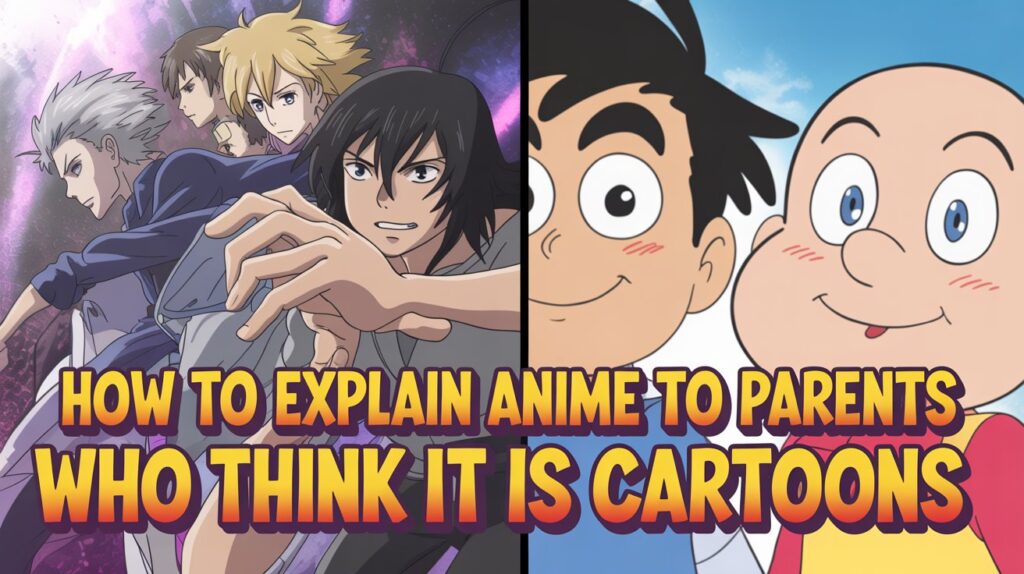
When Parents Finally Understand
Sometimes acceptance takes time.
Parents are influenced by their media exposure and generational upbringing.
If they see that:
- You manage responsibilities
- You choose meaningful content
- You are not isolating yourself
They gradually realize that anime is not harmful.
In fact, they may even start asking questions about your favorite series.
Final Perspective
Explaining anime to parents is not about winning an argument.
It is about shifting perspective.
Anime is:
- A storytelling medium
- A cultural art form
- A global entertainment industry
- A space for emotional exploration
When framed correctly, anime stands on equal footing with cinema, literature, and television drama.
The next time someone says anime is “just cartoons,” you will have the knowledge and clarity to explain otherwise, respectfully and confidently.
And who knows, one day you might find your parents recommending an anime film to you.
The Semiotics of Animation: Why Form Does Not Define Maturity
One of the most important theoretical points to explain to parents is the difference between form and content. Animation is a form. Maturity is determined by content.
In media theory, the medium is simply the vehicle through which a story is delivered. Just as ink on paper does not determine whether a book is childish or profound, drawn frames do not determine whether a story is simplistic or complex. The misunderstanding arises when people confuse the aesthetics of a medium with its intellectual depth.
Anime uses stylized visuals, but the narrative architecture beneath those visuals can be as layered as classical literature or modern cinema. The presence of color and exaggerated expressions does not negate thematic sophistication.
When parents understand that animation is a narrative technique rather than a genre classification, the entire debate shifts from dismissal to evaluation.
Narrative Structure in Anime: A Comparative Lens
From a storytelling theory perspective, anime frequently employs advanced narrative structures. Many series use nonlinear storytelling, unreliable narrators, psychological symbolism, and multi-arc character evolution.
Unlike episodic children’s cartoons that reset after each episode, many anime follow long-form narrative design. This structure mirrors serialized novels or prestige television dramas. Character arcs often stretch across seasons, allowing gradual psychological development.
This serialized approach encourages audience investment, long-term thematic exploration, and philosophical layering. Parents who appreciate complex storytelling in literature or cinema may recognize similar structural depth once it is framed this way.
Archetypes and Mythology in Anime
Anime often draws from classical mythology, Jungian archetypes, and philosophical traditions. The hero’s journey, moral ambiguity, redemption arcs, tragic downfall, and existential questioning are recurring elements.
These are not childish constructs. They are foundational narrative devices found in Shakespearean drama, Greek tragedy, and epic literature. Anime adapts these archetypes into contemporary settings, making them accessible to modern audiences while retaining symbolic complexity.
Explaining this theoretical foundation helps reposition anime as mythological storytelling in a modern visual format.
Emotional Realism Versus Visual Stylization
Another theoretical concept worth explaining is emotional realism. Emotional realism refers to the authenticity of emotional experiences portrayed in a story, regardless of visual style.
Anime frequently excels in portraying internal conflict. Characters often articulate doubt, fear, guilt, ambition, and insecurity with unusual transparency. Internal monologues are common, allowing viewers to access psychological layers that live-action media sometimes avoids.
Parents may initially focus on external visuals, but emotional authenticity operates independently of artistic style. A drawn tear can represent grief as powerfully as a filmed performance if the narrative context is strong.
The Sociology of Media Evolution
The perception of anime as childish is partly a sociological phenomenon. Media evolves with technology, and each generation forms biases based on its formative media exposure.
Older generations often associate animation with early television programming targeted at children. Younger generations experienced globalization, streaming services, and access to international storytelling. This divergence creates a cultural perception gap.
From a sociological standpoint, resistance to new media forms is historically common. Novels were once criticized as distractions. Television was once considered intellectually inferior to books. Video games were once labeled harmful without nuance.
Anime falls into this historical pattern of misunderstood emerging media forms. Over time, normalization tends to occur as exposure increases.
Anime as a Reflection of Postmodern Storytelling
Modern storytelling increasingly embraces moral ambiguity, antiheroes, and complex ethical landscapes. Anime reflects this postmodern trend strongly.
Instead of clear-cut good versus evil narratives, many anime explore gray moral zones. Characters often confront ethical dilemmas where no solution is entirely correct. This philosophical framing encourages critical thinking rather than passive consumption.
Parents who value intellectual discussion may find that anime fosters debate about justice, identity, power, and societal structure.
Psychological Catharsis and Identification
From a psychological perspective, anime often provides catharsis. Catharsis is the emotional release that occurs when viewers connect deeply with fictional experiences.
Anime characters frequently undergo intense emotional struggles. Because animation allows exaggerated expressions and symbolic imagery, it can externalize internal pain in ways that live action sometimes cannot.
This stylization can enhance identification rather than diminish it. Viewers may find it easier to project themselves onto stylized characters because they function symbolically rather than hyper-realistically.
This psychological mechanism explains why anime resonates strongly with adolescents and adults navigating identity formation and emotional growth.
Cultural Soft Power and Global Influence
Anime is also an example of cultural soft power. Soft power refers to the ability of a country to influence global perception through cultural exports rather than political force.
Japan’s global cultural footprint expanded significantly through anime. The medium communicates social values, aesthetic preferences, and philosophical themes to international audiences.
Explaining this geopolitical dimension can elevate the discussion. Anime is not merely entertainment. It functions as cultural diplomacy and international artistic exchange.
Parents often appreciate when hobbies are contextualized within broader societal impact.
Intertextuality and Literary Depth
Many anime works contain intertextual references to philosophy, religion, literature, and historical events. Intertextuality refers to the way texts reference or build upon other texts.
This layered referencing creates deeper engagement for viewers who recognize those influences. It transforms passive watching into interpretive analysis.
Parents who enjoy analyzing symbolism in films or novels may find that anime invites similar interpretive engagement. The complexity is not always immediately visible, but it often exists beneath the surface.
The Economics of Creative Industries
The anime industry operates within a sophisticated production ecosystem involving writers, animators, composers, voice actors, and international distributors.
Its economic footprint spans merchandising, global streaming rights, theatrical releases, and cultural tourism. This industrial complexity reflects professional artistic infrastructure, not amateur or child-focused production.
Understanding the professional scale of the industry can shift perception from “cartoon hobby” to “global creative enterprise.”
Identity Formation and Youth Psychology
For many young viewers, anime serves as a safe framework for exploring identity. Themes such as belonging, ambition, friendship, and moral responsibility resonate strongly during formative years.
Developmental psychology suggests that narrative consumption influences empathy and moral reasoning. Stories that depict internal struggle and growth can contribute to reflective thinking.
Parents concerned about maturity may find reassurance in the fact that thoughtful narrative engagement can support emotional development when consumed responsibly.
Media Literacy and Critical Engagement
Another theoretical point involves media literacy. Watching anime with awareness encourages analysis of themes, symbolism, and narrative structure.
Rather than passive entertainment, it can become an exercise in interpretation. Discussions about character motivations, ethical dilemmas, and plot symbolism foster analytical thinking.
Parents often value critical thinking skills. Framing anime as an opportunity for interpretive dialogue can reposition it as intellectually stimulating rather than trivial.
Artistic Innovation and Creative Freedom
Animation allows creative freedom beyond the constraints of physical filmmaking. Worlds can be constructed without budgetary limits tied to physical sets or practical effects.
This freedom enables abstract storytelling, imaginative metaphors, and speculative world-building. Science fiction and fantasy concepts can be explored visually without compromising narrative ambition.
From an artistic theory standpoint, animation expands the boundaries of storytelling rather than limiting them.
The Philosophy of Escapism
Escapism is often misunderstood as avoidance. However, philosophical discussions suggest that controlled escapism can provide restoration, reflection, and imaginative expansion.
All forms of entertainment provide some degree of escape. Reading novels, watching films, or attending theater performances temporarily removes individuals from daily stress.
Anime functions similarly. The difference lies only in stylistic presentation. Responsible escapism can coexist with productivity and maturity.
Moral Complexity and Ethical Inquiry
Anime frequently presents ethical dilemmas without prescribing simple answers. This ambiguity encourages viewers to form independent judgments.
Stories that avoid clear moral binaries promote cognitive engagement. Viewers must assess consequences, motivations, and long-term impact.
This type of storytelling aligns with higher-level ethical reasoning rather than simplistic moral lessons.
Generational Media Evolution Theory
Every generation adopts a dominant cultural medium that older generations initially question. Over time, that medium becomes normalized.
Cinema was once controversial. Television was once dismissed. Video games faced skepticism. Now, anime occupies a similar transitional space in some households.
Historical precedent suggests that as exposure increases and critical appreciation grows, resistance gradually diminishes.
The Distinction Between Content Rating and Medium
A final theoretical clarification involves content rating systems. Age appropriateness is determined by thematic content, not by whether a work is animated or live action.
Some anime is designed for children. Some is intended for mature audiences. The same applies to films and novels.
Conflating the medium with the intended audience oversimplifies a complex creative landscape.
Concluding Reflection
At its core, the debate about anime being “just cartoons” reflects a broader misunderstanding about media classification.
Animation is a storytelling technique. Anime is a culturally specific form of that technique. Maturity depends on narrative intention, thematic depth, and audience design.
When explained through media theory, psychology, sociology, and cultural analysis, anime emerges not as childish diversion, but as a legitimate artistic medium capable of profound storytelling.
Understanding begins when we shift from judging by appearance to evaluating by substance.
Also Read: “Why Anime Feels More Emotional Than Movies: Science of Storytelling“
FAQs
Is anime suitable for adults?
Yes. Many anime series are created specifically for mature audiences and explore complex psychological and social themes.
Why do parents think anime is for kids?
Because animation in many countries historically targeted children, creating a long-standing association between cartoons and childhood.
How can I convince my parents to watch anime?
Start with emotionally rich, universally appealing films and invite them to watch together without pressure.