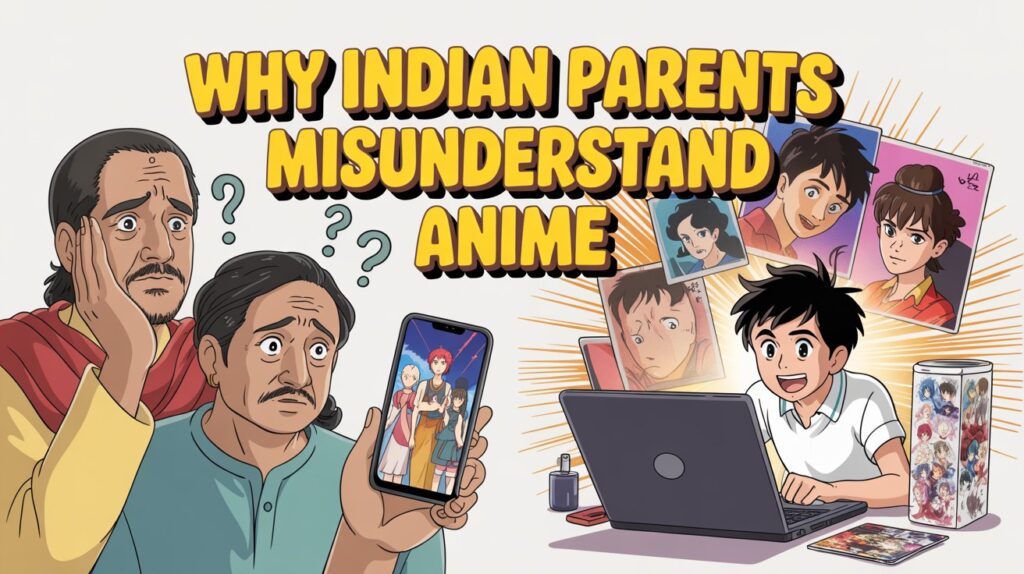

In many Indian households, anime is still described with one familiar word: cartoons. For countless young fans, that single label carries frustration, dismissal, and misunderstanding. Parents often see anime as childish, distracting, or even culturally inappropriate. Meanwhile, their children see it as emotionally powerful storytelling, artistic expression, and community identity. Why Indian parents misunderstand anime.
This gap is not simply about taste. It is rooted in generational media exposure, cultural values, historical broadcasting patterns, and psychological perception.
In this in-depth analysis, we explore why Indian parents misunderstand anime, how these perceptions formed, and whether this gap is slowly narrowing.
Table of Contents
The Cartoon Conditioning Effect
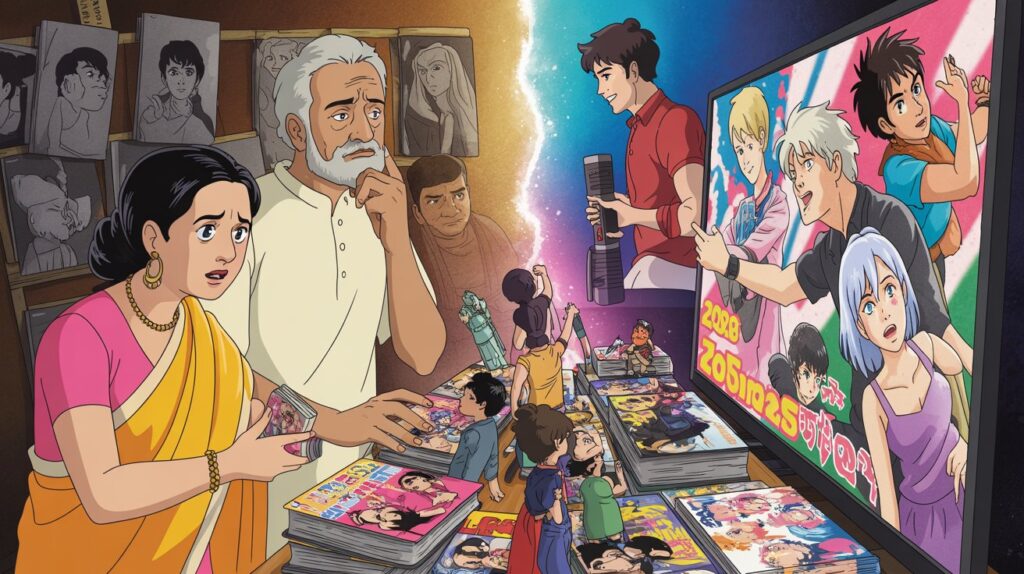
For many Indian parents, animation equals children’s programming. This belief did not appear randomly. It was shaped by television history.
During the 1990s and early 2000s, animated shows broadcast in India were overwhelmingly child-focused. Western cartoons dominated cable TV. When anime like Dragon Ball Z or Pokémon aired, they were dubbed and scheduled in children’s programming slots.
Parents associated animation with:
- After-school viewing
- Weekend morning entertainment
- Child-centric humor
From their perspective, animation was never presented as adult storytelling. This early media conditioning shaped long-term perception.
When their children later watched anime with mature themes, parents still filtered it through that old framework.
The Generational Media Gap
The media environment Indian parents grew up in was limited and controlled. Television channels were few. International content was restricted. Access to global media required physical import or satellite expansion.
In contrast, today’s youth consume content across borders instantly. Streaming platforms provide access to global libraries. Subtitles are normalized. Foreign storytelling is mainstream.
This creates a generational gap in exposure.
Parents may not understand why someone would choose Japanese animation over Indian cinema or Western shows. It feels unfamiliar and unnecessary.
But for younger audiences, global content is normal.
Misunderstanding often emerges not from rejection, but from unfamiliarity.
Visual Stylization Versus Emotional Depth
Anime’s exaggerated expressions, colorful hair, and stylized visuals often confuse parents.
Indian parents, accustomed to live-action storytelling, may interpret animation aesthetics as childish exaggeration rather than artistic choice.
However, stylization does not eliminate emotional depth.
Series like:
- Death Note
- Attack on Titan
- Naruto
explore morality, war trauma, ambition, revenge, and identity crisis.
Yet many parents never move beyond first impressions of art style.
They see color. Children see complexity.
This disconnect reinforces misunderstanding.
Academic Pressure and Productivity Concerns
Indian households often prioritize academic success, career stability, and time efficiency.
Entertainment is frequently evaluated through productivity lenses.
Parents may view anime as:
- Time-consuming
- Addictive
- Distracting from studies
Long-running series with hundreds of episodes intensify this concern.
From their perspective, binge-watching animation appears less productive than studying or skill development.
What they may not realize is that narrative engagement can enhance creativity, language exposure, and emotional intelligence when balanced responsibly.
The conflict is less about anime specifically and more about time allocation.
Cultural Familiarity Bias
Humans tend to prefer familiar cultural frameworks. Indian parents grew up with Bollywood, regional cinema, mythological TV serials, and family dramas.
Anime storytelling follows different pacing, symbolism, and cultural norms.
Themes such as:
- Japanese school systems
- Honor-based dynamics
- Shinto-inspired symbolism
- Subtle emotional expression
may feel distant or confusing.
Unfamiliar cultural cues can create discomfort. That discomfort sometimes transforms into dismissal.
It is easier to label something childish than to invest effort in understanding it.
The Violence Perception Problem
Some anime contains intense action sequences. Without context, certain scenes may appear violent or dark.
Parents who walk into a room during a dramatic battle sequence might see only aggression, not narrative purpose.
For example, Demon Slayer: Kimetsu no Yaiba contains stylized combat. Without context, it may appear graphic. With context, it explores family bonds and sacrifice.
Selective exposure creates incomplete impressions.
This reinforces skepticism.
Language Barrier and Subtitle Resistance
Many Indian parents are not comfortable reading subtitles. They prefer content in Hindi or regional languages.
Subtitled anime can feel inaccessible.
If parents cannot understand dialogue directly, they cannot evaluate narrative depth. What remains visible are visual elements, which they may misinterpret.
As more anime receives Hindi dubbing, this barrier may gradually decrease.
The “You Are Too Old for Cartoons” Narrative
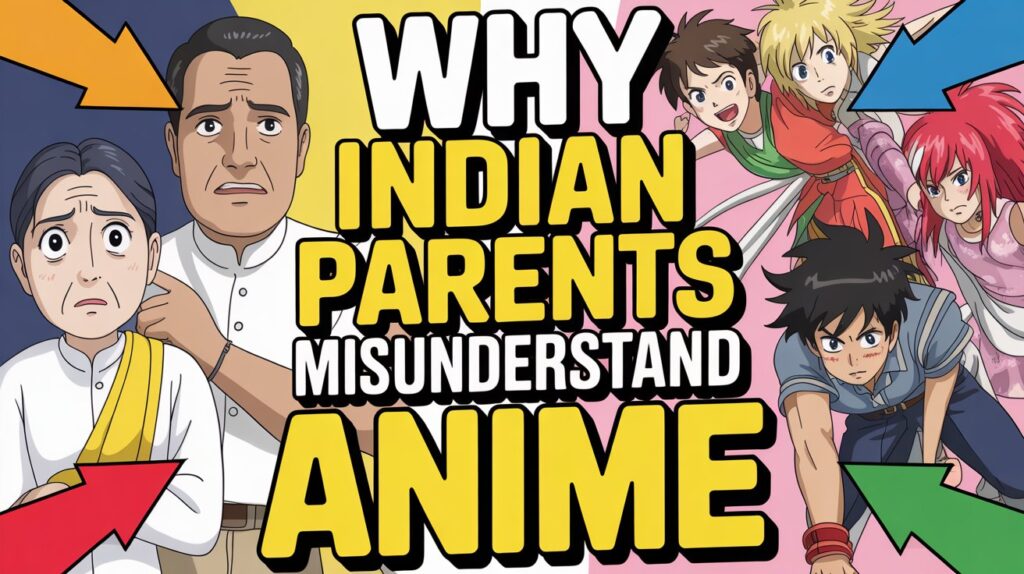
Age expectations strongly influence perception.
Parents often categorize animation as something children outgrow.
When teenagers or adults continue watching anime, it conflicts with parental assumptions about maturity.
However, animation in Japan has always included demographic categories for teens and adults.
The misunderstanding lies in assuming that medium equals audience.
In reality, audience depends on content.
Historical Lack of Institutional Validation
For many years, anime in India existed without formal institutional support.
It was not widely discussed in mainstream media. It rarely received theatrical releases. Educational institutions did not analyze it. Film critics seldom reviewed it seriously.
Without institutional validation, parents had little reason to consider anime culturally significant.
This has started changing with theatrical releases of films such as:
- Demon Slayer: Mugen Train
- Suzume
Cinema releases signal legitimacy.
Institutional recognition influences perception.
Misinterpretation of Fandom Intensity
Anime fandom is passionate. Fans collect merchandise, attend conventions, and engage in online discussions.
To parents unfamiliar with fandom culture, this intensity may appear obsessive.
However, similar passion exists in cricket fandom, Bollywood celebrity culture, and sports leagues.
The difference lies in generational relatability.
Parents may understand devotion to cricket, but not devotion to fictional characters.
It is a relatability issue, not necessarily a rational judgment.
Social Media Amplification and Stereotypes
Online stereotypes often portray anime fans as socially awkward or overly obsessive.
Parents exposed to such stereotypes may develop negative assumptions.
Algorithm-driven content sometimes amplifies extreme examples rather than balanced representation.
This can distort perception further.
Comparing Parental Concerns With Reality
| Parental Concern | Reality Check |
|---|---|
| Anime is childish | Many series target adult audiences |
| Anime is violent | Violence depends on genre, similar to films |
| Anime wastes time | Time management determines impact |
| Anime promotes foreign values | Stories often emphasize universal themes |
Clarifying misconceptions requires calm dialogue rather than confrontation.
Psychological Roots of Resistance
Psychologically, parents often equate unfamiliar hobbies with risk.
Protective instincts amplify skepticism toward foreign cultural products.
Additionally, control over children’s media exposure historically rested with parents. Digital access reduces that control.
Loss of control sometimes manifests as criticism.
Understanding this psychological layer can reduce conflict.
Nostalgia Bias
Parents compare current media consumption to what they experienced growing up.
Nostalgia bias makes earlier entertainment appear superior.
Anything different may be judged harshly.
Anime’s distinctive style contrasts sharply with older Indian television aesthetics.
Difference often triggers resistance.
Slowly Changing Perceptions
Despite misunderstandings, attitudes are evolving.
Several trends are helping:
- Theatrical anime releases
- Hindi dubbing expansion
- Indian celebrities discussing anime
- Anime-themed merchandise availability
- Growth of conventions like Comic Con India
Visibility reduces stigma.
Exposure fosters familiarity.
The Role of Dialogue
Misunderstanding often persists because conversations become defensive.
When anime fans react emotionally, parents may interpret that as immaturity.
When parents dismiss anime immediately, children feel unheard.
Constructive dialogue requires:
- Explaining themes calmly
- Showing age-appropriate content
- Demonstrating time balance
- Inviting shared viewing experiences
Understanding grows gradually.
Media Evolution Is Cyclical
Every generation questions the next generation’s entertainment choices.
Television once faced criticism. Video games faced moral panic. Social media faced skepticism.
Anime in India fits into this pattern of generational transition.
Over time, normalization typically occurs.
A Broader Cultural Context
India is a society in transition between traditional and global influences.
Anime represents globalization. Parents may worry about cultural dilution.
However, many anime themes, such as respect for elders, perseverance, friendship, and sacrifice, align with Indian values.
The perceived clash often disappears upon closer inspection.
Final Reflection
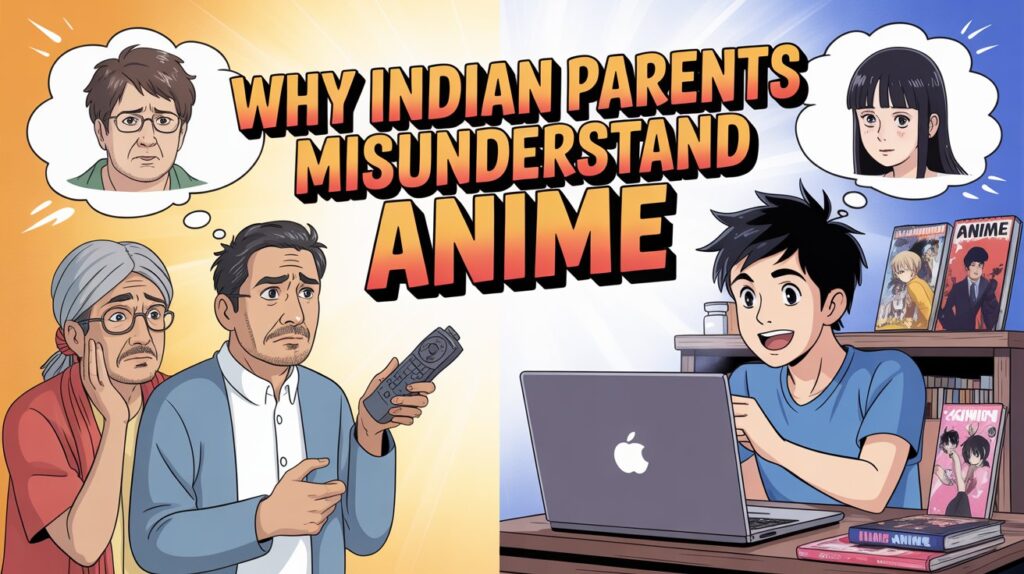
Indian parents misunderstand anime for multiple reasons:
- Historical association of animation with children
- Limited exposure to global storytelling
- Cultural unfamiliarity
- Academic priority mindset
- Language barriers
- Generational perception gaps
But misunderstandings are not permanent.
As anime becomes more visible in Indian cinemas, streaming platforms, and mainstream conversations, perceptions are shifting.
The key lies in patience, communication, and responsible consumption.
Anime is not merely “cartoons.” It is a storytelling medium shaped by culture, creativity, and emotional depth.
Understanding requires more than a glance at the screen. It requires openness.
And openness, like fandom, grows over time.
The Media Framing Theory and Its Influence
Media framing theory explains how the presentation of content shapes audience interpretation. In India, animation was historically framed as children’s entertainment through programming schedules, advertising, and channel branding.
When anime first entered Indian households, it was placed within children’s television blocks. Advertisements targeted kids. Promotional material emphasized toys rather than themes. This framing created a cognitive shortcut in parental perception.
Once a medium is framed in a particular way, it becomes difficult to reclassify it. Even when anime later expanded into darker and more philosophical territory, the original frame remained intact in the minds of many parents.
Reframing requires institutional signals such as theatrical releases, adult marketing campaigns, and serious critical reviews. Until that reframing becomes widespread, older interpretations persist.
Cultural Protectionism and Value Preservation
In societies with strong family structures, there is often a tendency toward cultural protectionism. Cultural protectionism refers to the instinct to safeguard traditional values from perceived external influence.
Anime, as a foreign cultural product, may be viewed through this lens. Parents may fear subtle shifts in language, behavior, or worldview influenced by non-Indian storytelling traditions.
However, this concern frequently overlooks the fact that Indian youth already consume Western films, global music, and international sports culture. Anime simply becomes the most visible symbol of globalization in the household.
The misunderstanding arises when anime is perceived as a threat rather than a creative medium.
The Cognitive Bias of Surface Judgment
Psychologically, humans rely on heuristics, mental shortcuts used to make quick judgments. One such shortcut is surface judgment, evaluating depth based on appearance.
Bright visuals, animated characters, and stylized expressions trigger associations with childhood programming. The brain categorizes quickly without deeper analysis.
Overcoming this bias requires exposure and context. When parents watch full narratives instead of short clips, the heuristic begins to weaken.
Until then, perception remains shallow because the evaluation method is superficial.
The Moral Panic Cycle
Sociologists describe moral panic as a recurring pattern in which new media forms are accused of corrupting youth.
This cycle has repeated with:
- Comic books
- Television
- Video games
- Social media
Anime occasionally falls into this cycle. Reports of violent scenes or obsessive fandom can trigger generalized fear.
Moral panic simplifies complex media ecosystems into single narratives of danger. It does not account for genre diversity or audience responsibility.
Understanding anime through the lens of moral panic reveals that resistance is often part of a broader historical pattern rather than a unique cultural flaw.
Symbolism Misinterpretation and Context Loss
Anime frequently uses symbolic imagery derived from Japanese culture, mythology, and aesthetics.
Without contextual knowledge, symbols may appear strange or exaggerated. Visual metaphors, spiritual references, or cultural rituals might seem alien.
Parents unfamiliar with this symbolism may misinterpret intent. What is metaphorical may be taken literally. What is culturally specific may be perceived as confusing.
Symbolic literacy requires background awareness. Without it, depth can be mistaken for randomness.
Authority Dynamics and Media Autonomy
In traditional family structures, parents historically controlled media access. Television channels were limited. Scheduling was predictable.
The digital era shifted this balance. Young people now select content independently through smartphones and laptops.
This autonomy can create subtle tension. When control decreases, skepticism may increase.
Criticism of anime may sometimes represent broader discomfort with declining parental oversight in digital consumption.
The misunderstanding becomes less about content and more about authority transition.
The Productivity Paradigm in Indian Households
Indian middle-class culture often emphasizes measurable productivity. Hobbies are evaluated based on career relevance or tangible skill development.
Anime, like most entertainment, does not always present obvious professional outcomes. It is narrative immersion rather than skill certification.
Within a productivity-centered mindset, immersive entertainment may be perceived as indulgent.
However, narrative engagement contributes to creativity, empathy, and stress relief, outcomes that are less quantifiable but equally meaningful.
The tension emerges from differing definitions of value.
Cross-Cultural Narrative Styles
Indian storytelling traditions often emphasize melodrama, musical expression, and extended family dynamics. Anime storytelling may rely on internal monologues, slower emotional pacing, and symbolic silence.
When narrative styles differ, relatability decreases.
Parents accustomed to overt emotional expression may interpret subtle anime scenes as exaggerated or unnecessary.
Narrative style unfamiliarity can appear as narrative immaturity, even when the opposite is true.
Collective Memory and Media Hierarchy
Every generation establishes a hierarchy of respectable media forms. Literature may sit at the top, followed by cinema, then television, and finally animation.
This hierarchy is socially constructed rather than objectively defined.
In India, animated media historically occupied the lowest rung. Without conscious reassessment, that ranking persists.
Changing hierarchy requires cultural shifts, critical acclaim, and broader acceptance of animation as cinematic art.
Until then, anime remains positioned below “serious” media in the parental mental hierarchy.
Emotional Intensity and Misreading of Vulnerability
Anime often portrays intense emotional vulnerability. Characters cry openly, confront trauma, and articulate insecurity.
In certain cultural contexts, overt emotional expression can be misread as exaggeration or immaturity.
Parents raised in emotionally restrained environments may interpret this vulnerability as melodrama rather than psychological honesty.
The difference lies in emotional norms between generations.
Globalization Anxiety
Globalization brings opportunity but also uncertainty. Foreign media can symbolize shifting cultural landscapes.
Anime, as a distinctly Japanese medium, may represent change. For some parents, change triggers caution.
This reaction is not unique to India. Similar patterns occur worldwide when foreign media gains popularity among youth.
Understanding this anxiety contextualizes resistance as transitional rather than permanent.
The Role of Language Familiarity
Language shapes emotional connection. When parents cannot fully understand dialogue, nuance is lost.
Subtitled content requires cognitive effort. Without fluency, it becomes harder to evaluate quality.
This barrier may lead to dismissal rather than exploration.
As localized dubbing increases, perception may gradually soften because accessibility improves comprehension.
The Social Comparison Effect
Parents often compare their children’s hobbies with those of peers’ children.
If anime is perceived as unconventional within a social circle, skepticism intensifies.
Conversely, when multiple families normalize anime viewing, acceptance grows.
Social comparison influences judgment more than personal evaluation.
Identity Signaling and Generational Distance
For many young Indians, anime functions as identity signaling. It differentiates them from older generations.
This distinction may unintentionally widen the generational divide.
When a hobby becomes a symbol of youth identity, parents may interpret it as rejection of traditional norms.
Understanding anime then becomes intertwined with generational identity negotiation.
Information Asymmetry
Misunderstanding persists when one party possesses significantly more knowledge than the other.
Anime fans often understand genre distinctions, thematic layers, and cultural references. Parents may rely on brief observations.
Information asymmetry creates interpretive imbalance.
Bridging this gap requires explanation without defensiveness.
Transitional Cultural Phase
India is navigating rapid technological and cultural shifts. Media consumption patterns are evolving faster than intergenerational communication frameworks.
Anime exists within this transitional phase.
As streaming becomes universal and exposure increases, cultural unfamiliarity will likely decrease.
Historical patterns suggest that today’s controversial media often becomes tomorrow’s nostalgic classic.
The Long-Term Outlook
Theoretical models of cultural adoption suggest that resistance diminishes through:
- Increased exposure
- Institutional validation
- Localization
- Peer normalization
- Intergenerational dialogue
Anime in India is currently in mid-transition between skepticism and normalization.
Misunderstanding is not static. It reflects evolving media landscapes.
As more parents encounter anime through cinema releases, dubbed streaming, and mainstream discussion, perception will gradually shift from dismissal to curiosity.
And curiosity, once sparked, often leads to understanding.
Also Read: “This Anime Scene Changed How Fans Look at Life“
FAQs
Why do Indian parents think anime is for kids?
Because animation on Indian television historically targeted children, shaping long-term perception.
Is anime appropriate for adults?
Yes. Many anime series are specifically written for teenage and adult audiences.
How can someone help their parents understand anime?
By calmly explaining themes, choosing accessible content, and demonstrating balanced viewing habits.